


Launching an eyewear brand, outfitting a corporate retreat, or stocking a retail boutique presents a unique supply chain challenge. The internet is flooded with vendors promising high-quality, customizable eyewear at rock-bottom prices. However, when you actually receive the shipment, the reality often hits hard: crooked logos, brittle plastic frames, and lenses that fail basic UV400 compliance tests. Purchasing bulk sunglasses with logo branding is a significant capital investment, and making the wrong supplier choice can irreparably damage your brand’s reputation.

From our experience engineering and manufacturing premium eyewear, the sourcing channel you select dictates your profit margins, your quality control, and your lead times. In most professional situations, bypassing middlemen to work directly with a specialized manufacturer yields the best results. However, different business models require different sourcing strategies. In this comprehensive guide, we strip away the marketing fluff to reveal the 5 legitimate places to source custom eyewear, explaining not only what they are, but whether they are actually worth using for your specific commercial needs.
Quick Answer: Where Should You Buy Bulk Custom Sunglasses?
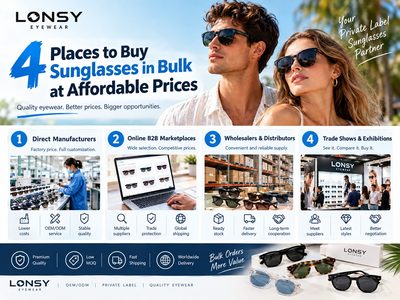
If you are looking to source bulk sunglasses with logo applications, you have five primary avenues. Your choice depends entirely on your required quality and volume:
- Direct Eyewear Manufacturers: The absolute best option for retail brands. Provides lowest unit costs, highest quality control (Acetate, TR90, Wood), and total customization.
- Global B2B Marketplaces (Alibaba/Global Sources): Good for discovering factories, but fraught with hidden trading companies acting as middlemen.
- Promotional Product Suppliers: Best for cheap, one-off event giveaways (weddings, corporate retreats). Terrible for retail resale due to low-grade materials.
- Domestic Wholesalers: Fast shipping and local communication, but you will pay a 40% to 60% markup for the convenience.
- Print-on-Demand (POD) Platforms: Zero Minimum Order Quantity (MOQ), but the highest cost per unit. Only viable for testing designs.
For commercial users building a legitimate brand, we strongly recommend going straight to a Direct Eyewear Manufacturer to secure retail-grade quality and protect your profit margins.
Table of Contents
- What is Custom Logo Eyewear Sourcing?
- How Bulk Customization Works
- The 5 Places to Source Bulk Sunglasses
- Quick Summary Comparison Table
- The Commercial Benefits of Private Labeling
- Limitations and Hidden Risks
- Pros and Cons of Direct vs. Middlemen
- Who Should Use It & Who Does Not Need It
- Common Mistakes Buyers Make
- Expert Buying Considerations
- Comparison Table: Logo Printing Methods
- Expert Manufacturer Recommendation
- Frequently Asked Questions (FAQ)
What is Custom Logo Eyewear Sourcing?
Sourcing bulk sunglasses with logo branding—often referred to as Private Label or OEM/ODM manufacturing—is the process of purchasing unbranded (blank) eyewear in high volumes and having a supplier permanently apply your trademark to the product. This application can occur on the exterior temples, the interior temples, or directly onto the lens itself. The objective is to transform a generic commodity into a proprietary brand asset.
How Bulk Customization Works
Before choosing a platform, you must understand the mechanics of how logos are applied. Suppliers generally offer three methods. Pad printing utilizes a silicone stamp to transfer ink onto curved plastic or metal surfaces; it is highly affordable but can wear off over time. Laser engraving physically burns the logo into the material, which is highly recommended for Wood Sunglasses and metal frames, offering absolute permanence. Finally, hot stamping presses a metallic foil into the frame using heat, yielding a luxury aesthetic often seen on premium acetate frames.
The 5 Places to Source Bulk Sunglasses With Logo
1. Direct Eyewear Manufacturers (The Industry Standard)
Partnering directly with an established overseas factory is the holy grail of product sourcing. You bypass all domestic markups, communicating directly with the engineers who mold the frames and cut the lenses. A direct manufacturer offers Custom Eyewear Manufacturing, meaning you are not limited to pre-existing shapes. You can choose the exact pantone color of your Fashion Sunglasses, dictate the hinge quality (e.g., standard vs. 5-barrel spring hinges), and ensure true UV400 or polarized lens compliance.
2. Global B2B Marketplaces (Alibaba, Global Sources, Made-in-China)
These massive directories host thousands of suppliers. While you can find excellent partners here, it is a high-risk environment. The platform is saturated with “Trading Companies”—middlemen who pose as factories. They take your order, add a 20% margin, and outsource the production to the cheapest, lowest-bidding sweatshop. If you use these platforms, you must rigorously audit the supplier’s business licenses to verify they own actual manufacturing equipment.
3. Promotional Product Distributors (4imprint, DiscountMugs, etc.)
If you need 500 pairs of neon sunglasses with a corporate logo for a weekend tech conference or a beach wedding, this is your route. However, we must issue a severe warning: do not use these platforms for retail resale. Promotional suppliers utilize the cheapest, injection-molded polystyrene (PC) plastics available. The lenses are often low-grade acrylic with dubious UV protection. They are built for one-day use, not for building a reputable eyewear brand.
4. Domestic Wholesale Importers
Domestic wholesalers import massive containers of blank eyewear from Asia, warehouse it in the US or Europe, and offer localized logo printing. The benefit here is speed; you can receive your bulk sunglasses with logo in a matter of days rather than weeks. The drawback is financial. You are paying for their ocean freight, their warehouse rent, and their localized labor. Expect to pay a 40% to 60% premium per unit compared to sourcing directly from the factory.
5. Print-on-Demand (POD) Platforms
POD services have begun offering eyewear. They require zero inventory investment. When your customer buys a pair of glasses on your website, the POD platform prints the logo and dropships it. While this eliminates upfront capital risk, the unit economics are terrible. You will pay near-retail prices for the base product, leaving you with razor-thin profit margins. It is a tool for testing designs, not for scaling a business.
Quick Summary Comparison Table
| Sourcing Channel | Unit Cost | Product Quality | Customization Depth | Target Buyer |
|---|---|---|---|---|
| Direct Manufacturer | Lowest | Retail/Premium | Total (Materials, Shapes, Packaging) | Brands, Boutiques, Serious Retailers |
| B2B Marketplaces | Low to Medium | Variable (High risk of scams) | High (If actual factory is found) | Experienced Importers |
| Promotional Distributors | Low | Landfill-Tier (Giveaways) | Surface Print Only | Event Planners, Corporate HR |
| Domestic Wholesalers | High | Medium | Surface Print Only | Buyers needing 3-day delivery |
| Print-on-Demand | Highest | Low to Medium | Surface Print Only | Dropshippers testing markets |
The Commercial Benefits of Private Labeling
Why should you bother customizing eyewear? The answer is brand equity. In a highly saturated market, a generic pair of sunglasses competes solely on price. By investing in bulk sunglasses with logo applications, you transition the product from a commodity to a branded lifestyle accessory. A customized logo on a pair of Buffalo Horn Glasses signals luxury and justifies a premium retail markup of 300% to 500% over your landed cost.
Limitations and Hidden Risks
We believe in practical judgment: bulk sourcing is not without friction. The primary limitation of working with top-tier direct manufacturers is the Minimum Order Quantity (MOQ). A factory will not turn on its assembly line to produce 10 custom pairs. You must be prepared to order 100 to 300 units per colorway. Furthermore, ocean freight and customs clearance can add 30 to 45 days to your lead time, requiring rigorous inventory forecasting.
Pros and Cons: Direct Factory vs. Middlemen
| Sourcing Strategy | Pros (Advantages) | Cons (Disadvantages) |
|---|---|---|
| Direct Manufacturer | Maximum profit margins. Direct access to premium materials (Acetate, TR90). Strict compliance with FDA/CE standards. | Longer lead times due to international shipping. Higher initial capital outlay (MOQs). Requires clear technical communication. |
| Domestic Middlemen | Rapid shipping (3-7 days). Low or no MOQs. No customs or import tariff headaches. | Severe impact on profit margins. You are selling the exact same frames as competitors. Limited printing methods available. |
Who Should Use It & Who Does Not Need It
Who Should Use It: We recommend direct factory sourcing for commercial users, established eCommerce brands, optical retail chains outfitting Eyeglasses Frames, and aggressive startups with capital to invest in inventory. If your goal is to build a legitimate, long-term brand, controlling your supply chain is mandatory.
Who Does Not Need It: If you are a beginner simply looking to validate a business idea with zero capital, do not order 500 pairs of custom glasses. Utilize a POD service or a domestic wholesaler to test your market first. Only commit to bulk international orders once you have proven customer demand.
Common Mistakes Buyers Make
Expert Insight: The most catastrophic mistake we see new buyers make is completely ignoring regulatory compliance in pursuit of the lowest possible unit cost.
If you import sunglasses into the United States or Europe, they are legally classified as medical devices (to protect against UV radiation). They must pass the FDA Drop Ball Test for impact resistance and possess CE certification for UV400 protection. Cheap promotional vendors on generic marketplaces routinely fake these certificates. If customs officials test your shipment and it fails, it will be destroyed at your expense.
Another common mistake is neglecting the unboxing experience. A premium pair of glasses shipped in a cheap polybag feels like garbage. You must allocate budget for Custom Eyewear Packaging, including branded boxes, microfiber cloths, and Eyewear Accessories. The packaging is just as important as the product.
Expert Buying Considerations
When selecting a supplier, interrogate them on their materials. Do not accept generic “plastic.” For heavy-duty applications like Sports Sunglasses, demand TR90—a Swiss-engineered thermoplastic that is incredibly flexible and impact-resistant. For high-end fashion lines, insist on Mazzucchelli acetate, which is hand-polished and derived from cotton, avoiding the cheap, brittle feel of injection-molded polycarbonate (PC).
Comparison Table: Logo Printing Technologies
| Printing Method | Durability | Best Material Application | Visual Aesthetic |
|---|---|---|---|
| Pad Printing | Medium | PC, TR90, Metal | Clean, vibrant colors. Can rub off with heavy sweat. |
| Laser Engraving | Permanent | Wood, Metal, Bamboo | Burnt, etched, highly premium look. Cannot be colored. |
| Hot Stamping / Foil | High | Acetate | Luxury metallic shine (Gold/Silver). Highly resistant to wear. |
| Lens Etching | Permanent | CR-39, Polycarbonate Lenses | Subtle, high-end branding in the corner of the lens. |
Expert Recommendation: Lonsy Eyewear
In our testing and decades of industry experience, navigating the fragmented eyewear supply chain is unnecessarily risky if you do not have boots on the ground in manufacturing hubs. We strongly recommend partnering with a dedicated, professional factory that handles the entire vertical process.

Lonsy Eyewear – Professional Eyewear Manufacturer
Lonsy is an experienced eyewear factory focused on high-quality and handmade sunglasses and optical frames. Materials we use include acetate, metal, and wood. Making sure that our customers can easily get wholesale sunglasses and eyeglasses, we have created a complete eyewear collection, including acetate sunglasses, metal sunglasses, Custom Wood Sunglasses, eco-friendly bamboo sunglasses, eyeglasses, and accessories.
We have more than 500+ models ready in stock to choose from. These glasses are all at wholesale price, but offer excellent, retail-ready quality. We handle complete Custom Logo Printing in-house, ensuring your brand identity is executed flawlessly.
Frequently Asked Questions (FAQ)
What is the Minimum Order Quantity (MOQ) for custom logo sunglasses?
In most professional situations, direct manufacturers require an MOQ of 100 to 300 pieces per style/color for custom branding. If a supplier offers an MOQ of 10 pieces, they are likely a reseller applying cheap pad prints to generic stock, rather than manufacturing a custom batch.
Can I put my logo on both the frames and the lenses?
Yes. High-quality manufacturers can pad print or laser engrave your logo on the exterior and interior temples, and utilize precise laser etching to place a subtle logo in the upper corner of the actual lens, mimicking luxury sunglass brands.
Are cheap promotional sunglasses safe to wear?
Not always. Cheap promotional glasses often lack verified UV400 protection. Wearing dark lenses without UV protection causes your pupils to dilate, allowing more harmful UV radiation into the eye than if you wore no glasses at all. Always demand CE or FDA compliance certificates from your supplier.
Authoritative References & Industry Standards
To ensure your sourcing operations remain compliant and professional, we reference the following regulatory standards:
- U.S. Food and Drug Administration (FDA): Regulations governing the import of sunglasses as medical devices, including 21 CFR 801.410 (Drop Ball Test for impact resistance). Review FDA Device Regulations.
- International Organization for Standardization (ISO): ISO 12312-1 standards specifying the physical and optical properties required for sunglasses for general use. Review ISO 12312-1.
- Advertising Specialty Institute (ASI): Industry data on the lifecycle, material quality, and marketing ROI of custom promotional products versus retail-grade goods. Review ASI Industry Research.




Recent Comments